.svg)
.svg)


The Compression Effect is the pattern reshaping digital product development right now. AI has dramatically compressed the production-heavy phases of building a product: design, build and test now move in days where they used to take weeks. What it hasn't compressed, and arguably can't, is discovery. Understanding the real problem, the people involved, and how an organisation actually works remains stubbornly human. The consequence is simple but easy to miss: as the cost of building falls, the relative cost of building the wrong thing rises. The smart response isn't to spend less time thinking. It's to spend more.
Watching it happen in our own work
I've seen this compression first-hand, in weeks not years. We recently ran a half-day workshop with industry leads for Polyn, our organisational knowledge platform, and came away with a few hours' worth of transcript that would have been a mountain to unpick. We wanted to be in the conversation, not taking notes in the corner. So I gave Claude the transcript, alongside access to our codebase and product roadmap, and asked it to pull out the feature requests and measure each one against what we'd already built. The team got a readable document showing what was asked for, what already exists, and what's missing. We don't accept that analysis as fact. Some of it won't make sense against what we know of the codebase, and we question it. But it gives us something to interrogate, and analysis that would have eaten days took minutes. Our time went into the decision that actually matters: what fits the plan. Same with prototyping. A first working version of an idea that would once have taken a sprint can now exist by the end of the afternoon.
I'll be honest, these tools rarely get it right first time. I'm regularly in there going "this isn't how we'd tackle that" and questioning the output against what we know. But the production work, the shifting of information from one format into another, has genuinely collapsed. The way I think about it: we use AI to compress the admin, not skip the thinking.
The numbers back this up beyond our own experience. McKinsey has reported product development cycle times cut by up to 70% when generative AI is used properly across the lifecycle (source). In software, a controlled experiment with 95 professional developers found those using an AI coding assistant completed a standardised task 55.8% faster than those without (source). And here's the uncomfortable one: Pendo's research found 80% of features in the average software product are rarely or never used (source). That figure is from 2019, before any of this tooling existed. We were building the wrong things at scale when building was slow and expensive. Compression doesn't fix that problem. It industrialises it, unless the discovery improves too.
What stays human in product development
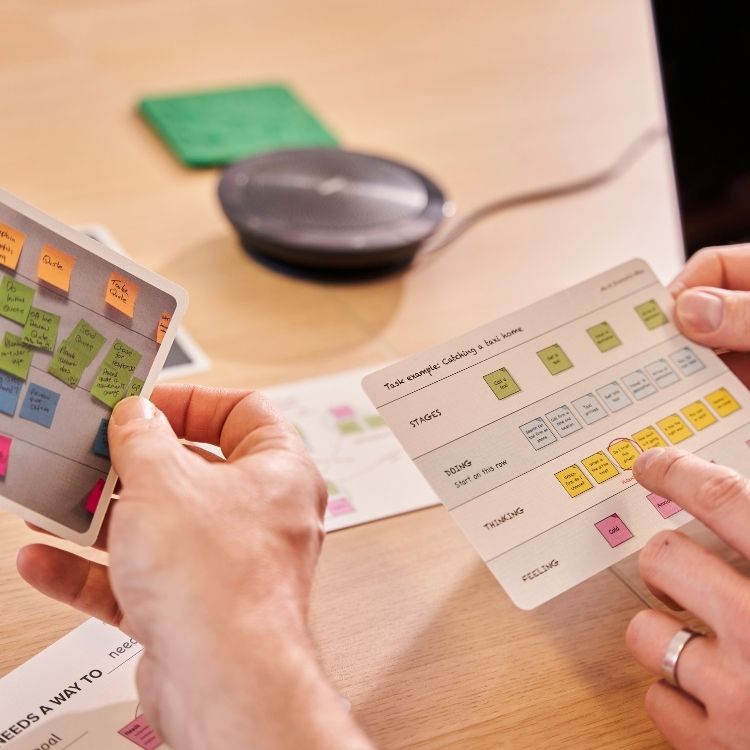
Discovery resists compression because, at the start of the process, the knowledge it surfaces isn't written down anywhere. It lives in people's heads, in workarounds, in the gap between how a process is documented and how it actually happens.
A story I keep coming back to: a manufacturer's data showed one supplier was always delivering late. The dashboard was unambiguous. But when a researcher walked the process, it turned out the deliveries arrived on time and simply weren't checked in until the next day. The data was accurate and the conclusion was wrong. No model, however capable, would have caught that from the data alone, because the answer wasn't in the data. It was in the room.
That's the shape of discovery work. AI can produce something coherent without ever holding the lived reality of the people it's meant to serve. It can tell you what's happening but it takes humans asking questions to find out why. The same goes for definition: deciding what V1 is, what's a minimum requirement versus a nice-to-have, and getting stakeholders genuinely aligned on it are negotiations, not documents.
What AI genuinely accelerates in product development
We're not AI sceptics. Quite the opposite. Designing, building and testing all move faster than they did eighteen months ago, and we use these tools daily: generating UI concepts and wireframes, drafting frontend code, iterating copy, widening QA coverage. We've written before about vibe coding and whether AI will replace UX designers, and the honest answer in both is that the production layer is being transformed.
But being transformed isn't the same as being handed over. We're not suggesting AI designs it all. Human inspiration, taste, and the ability to pull ideas in from completely different contexts are still where the interesting design work comes from. What AI does brilliantly is let those ideas be iterated on: try a direction, see it, bin it or push it further, in days instead of the weeks or months it used to take. More time being creative, less time moving a mouse around.
And that speed isn't just a cost saving, it's more shots at the goal. When production compresses, an idea can be in front of real users in days rather than months. You can design, build and test more often, learn from actual behaviour rather than roadmap debates, and course-correct while it's still cheap to change direction. The organisations getting the most from AI aren't the ones shipping one thing faster. They're the ones running more loops.
What this means for your organisation
If you're a digital leader or founder, the practical implication is a rebalancing of where you invest. Put more into discovery, not less, because it's now the highest-leverage phase you have. Treat cheap production as a reason to run more of those learning loops, not to skip validation. Be deliberate: use AI where its strengths lie, and make sure people are part of the process at every phase, whether that's adding experience and flavour in discovery and design, or judgement during development and iteration.
The organisations that get this right won't be the ones building fastest. They'll be the ones building things people actually use: products with real engagement, real impact, and a return that justifies the investment.
Start with the problem, not the build
Discovery is where we've always started at Elixel. We go into organisations, understand the people, the process and the technology, and help teams solve the right problem before a line of code gets written. If the Compression Effect is making you rethink how you deliver your projects, we'd love you to get in touch.
Newsletter
Sign up for monthly insights, concept designs and product tips
.webp)